In previous blog posts, I’ve talked about the context and themes of CounterPlay Leeds and now it’s time for action!
When hosting or participating in play events, I always aim to 1) play, 2) think about play and 3) talk about play. As part of the latter, I find it important to have a conversation about the future: where do we go from here? How do we create better conditions for play and the playful society?
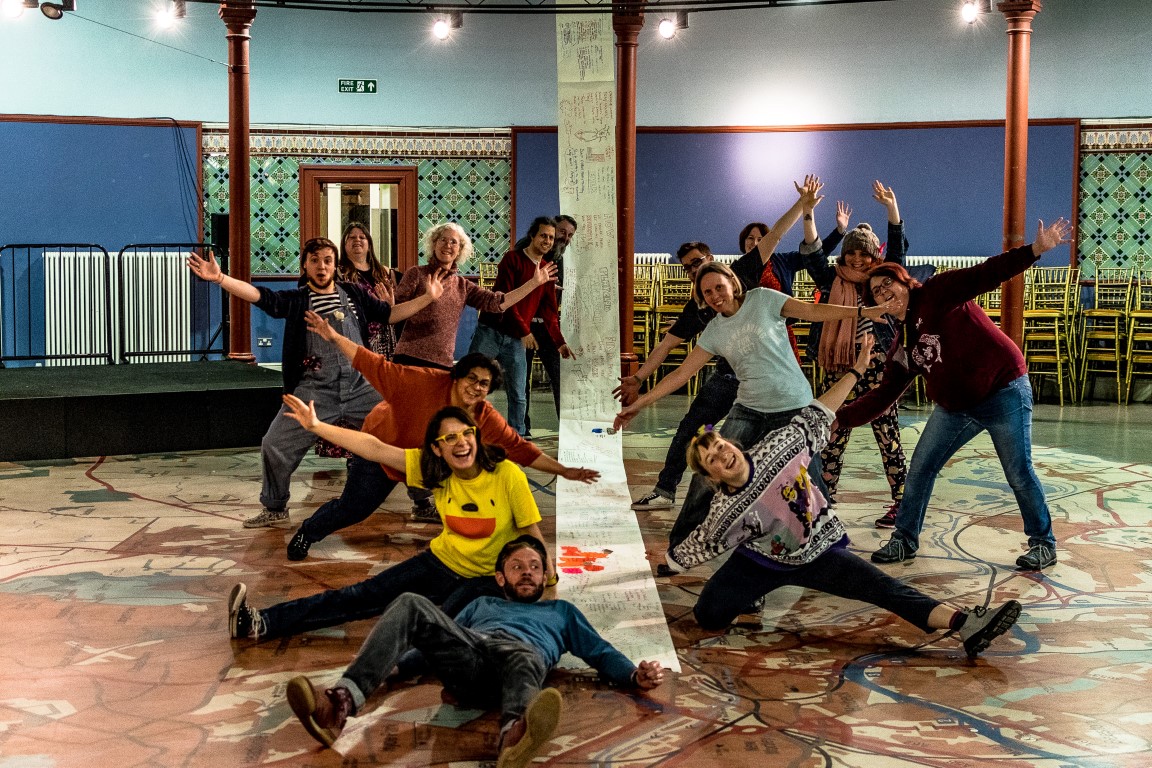
So many of the wonderful people in Leeds seemed really eager to explore these questions, and many good suggestions grew out of it. Actually, an entire scroll of ideas that (almost) crossed the entire room grew out of it!
Let’s look at some of them:
More CounterPlay events!
This was the first ever CounterPlay event outside Denmark, and I’m eager to support as many people as possible to build on our work and experiences from the first four festivals. There are currently something in the works in the Netherlands, Switzerland and again in the UK. This is very, very exciting, to say the least, and we’re preparing a guide to be used as inspiration, and if you’re interested in this, let us know.
Guardians of Play
This was an idea suggested by Portia Tung from School of Play: let’s be the playful, joyful, silly but earnest and dedicated Guardians of Play (like, you know, those other Guardians). It’s a nice way of framing our collective effort in a appropriately lighthearted manner, while reminding each other of the bigger picture:
We guard play to set it free and help it thrive.
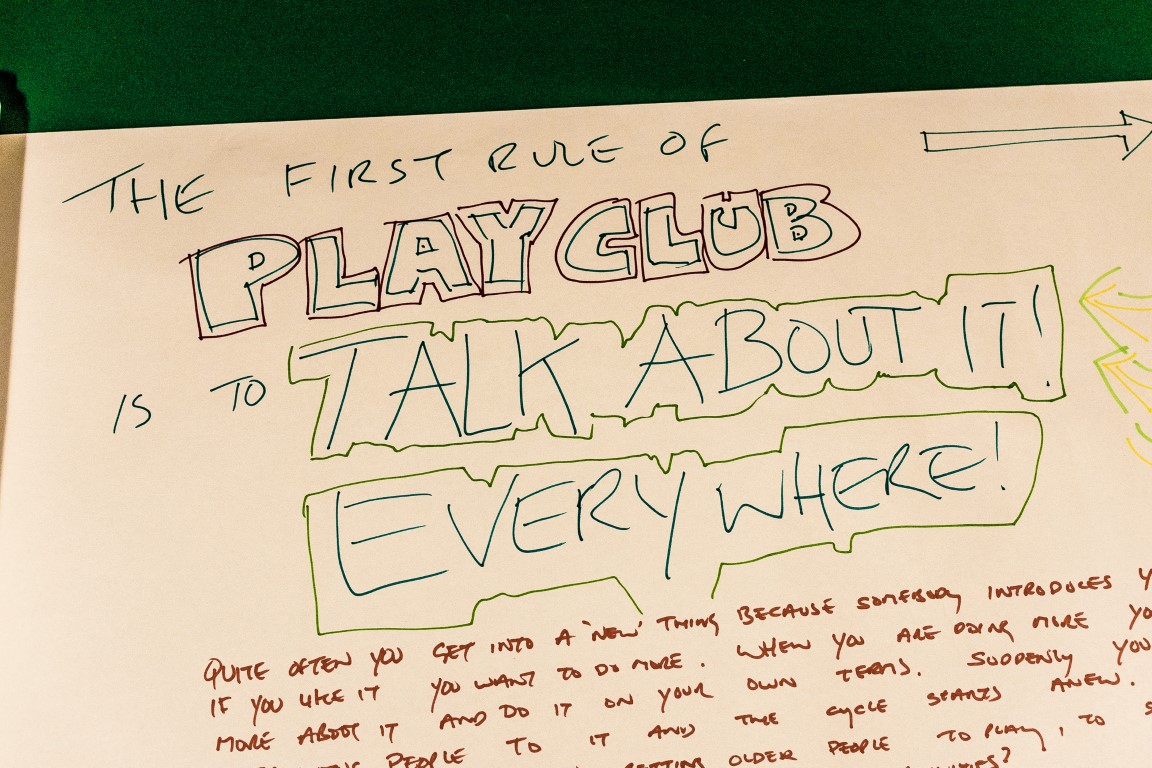
First rule of Play Club
With a thinly veiled reference to another, more insidious club, one of my new playful friends, Jim Thompson, suggested this wonderful rule for our play community: talk about it everywhere, to anyone, as much as possible.
“Talk is cheap” some say, but I say we need more of it. We need to tell stories about play and to develop a stronger, more nuanced language that more properly can capture the elusiveness of play. If we truly want to invite more people into our play community and to make society as a whole more playful, we need these stories and we need increased visibility.
Let’s meetup and talk more frequently; let’s write blog posts, articles and books; let’s host online conversations, seminars and courses; let’s make YouTube channels and videos; let’s get out into the streets and play.
In short, let’s make sure everyone knows play is a fully legitimate thing to engage in.
A hub for conversations
While many of us manage to stay in touch across borders using social media, we still need better ways of maintaining our connections and conversations. I actually think we may need something as old-school as an online forum. Yes, we have Twitter and Facebook and all that, but maybe we should have a thing that is our own? Where we can talk about everything and where conversations can unfold over time?
We’re currently looking into the forum service “Discourse” with the tagline “Civilized Discussion”. We could certainly use more of that, right? Any such forum will be open and free for anyone to use, but should also be properly moderated to ensure it remains friendly and welcoming.
If you have any experience with building forums, we’d love to hear from you. None of us are experts here.
The Chalk Brigade
I *love* chalk!
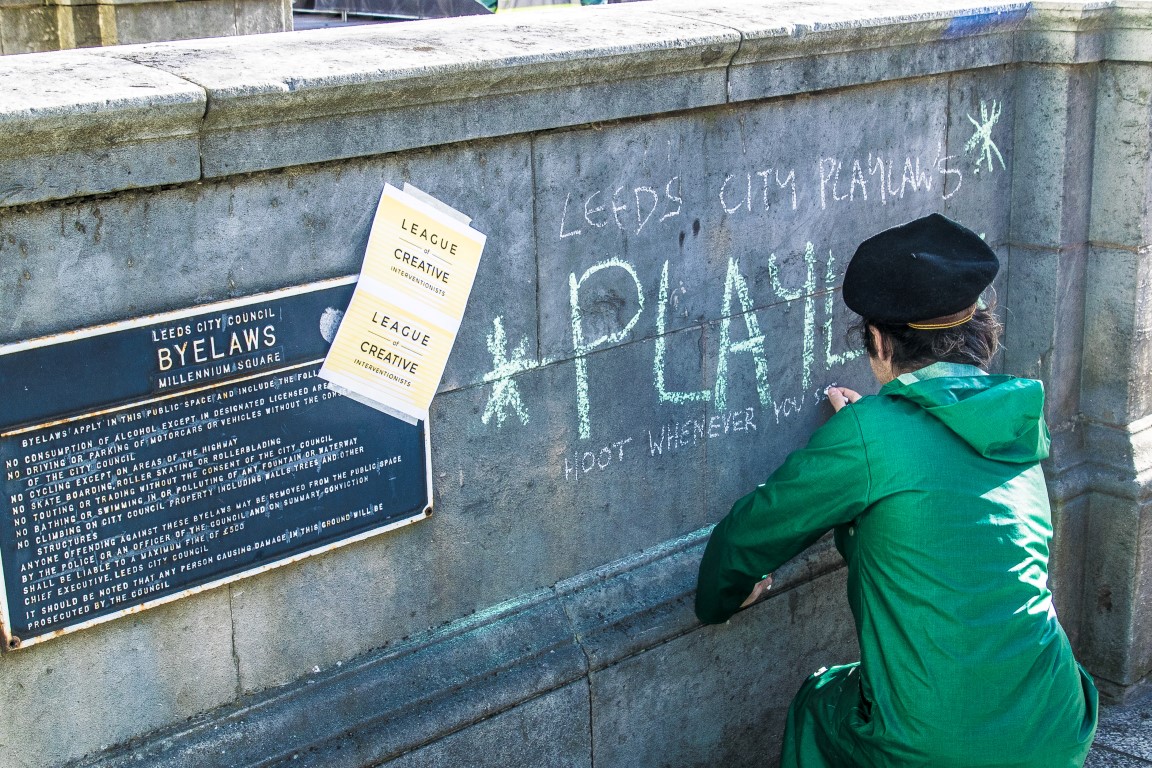
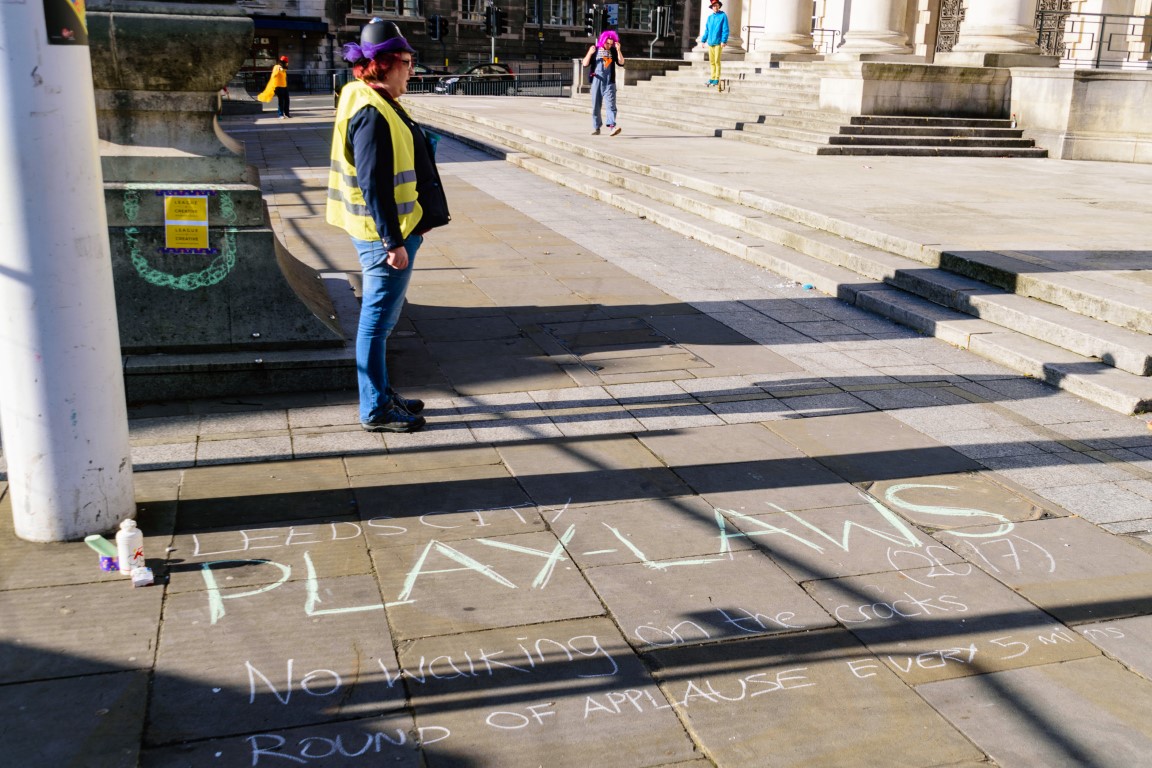
Making the “play-laws” in Leeds (read about it here) again reminded me how powerful this cheap, simple tool actually is. With a single piece of chalk you can become a rebel, challenging the ownership of public space and inviting play on the streets.
We talked about making “mission cards” for a playful “chalk brigade”, print the cards, stick a piece of chalk to each card and distribute them as far and wide as we can.
A Play Toolkit
Here here! Are these things we could see in a play toolkit?
In the conversation ensuing CounterPlay Leeds, Lynn Parker came upon the idea of a shared “Play Toolkit” and started unpacking the idea here. We think of it as an open-source project that can hopefully lead to both a set of instructions/principles and an actual, physical box. Stay tuned!
#OnePlayThing
Finally, we invented the hashtag #OnePlayThing to remind each other and everyone else how it’s often the small things, the small acts of play, that make a difference. If you wish to join, just share a photo, video or description of “one play thing”, one way of playing, on social media and tag it #OnePlayThing.
If you were among the participants, help me out: what am I forgetting? If you were not, which actions do you think we should take to make society more playful?
In my last post, I got into the background and context of the recent CounterPlay Leeds event. Now it’s time to explore the central themes as they emerged through play.
Diversity of play
Play reminds us that diversity and ambiguity are not something to be avoided, but rather to be embraced and encouraged. Play can be meaningful and important for all of us because it can take on so many forms and only those playing can determine whether or not this or that form of play is meaningful. If we can learn to accept and understand this, well, maybe we can carry that knowledge and respect with us into all aspects of life.
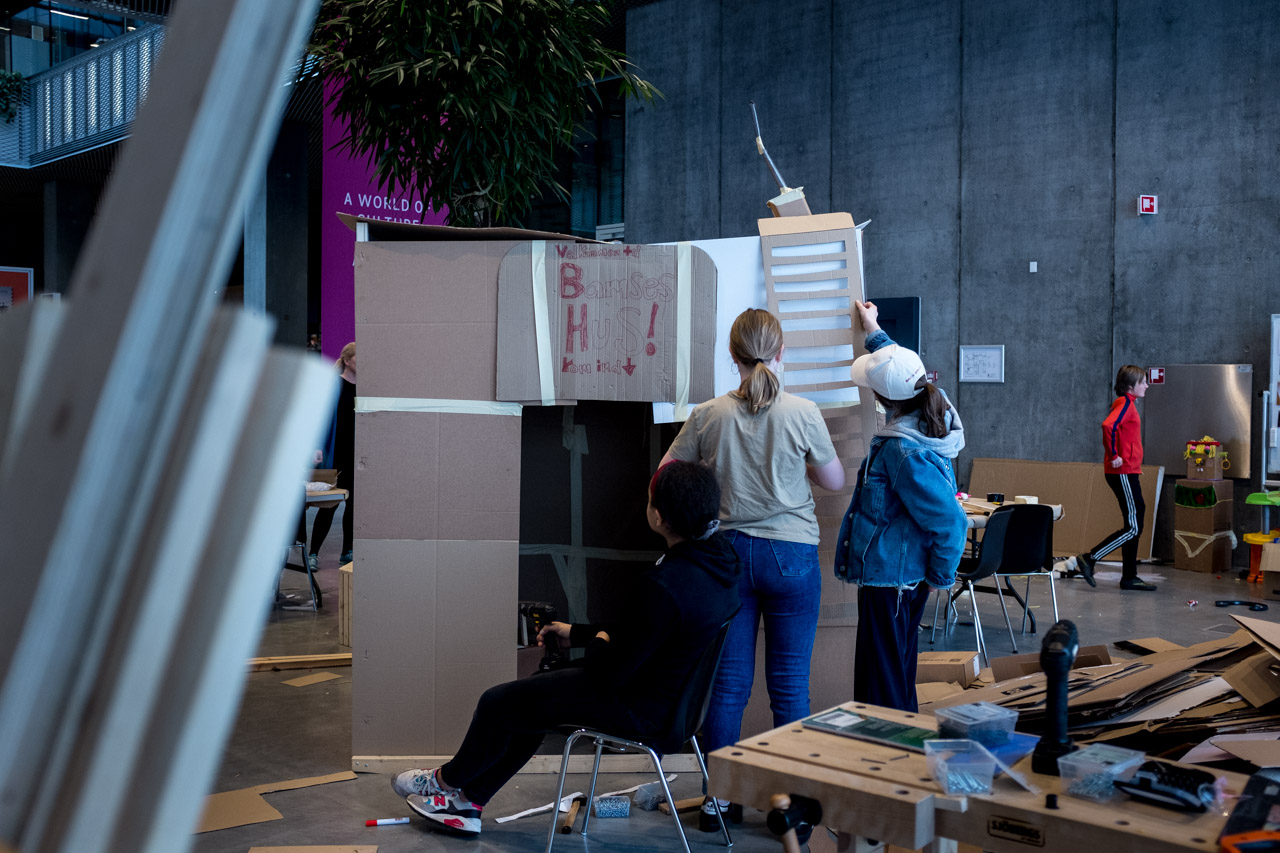
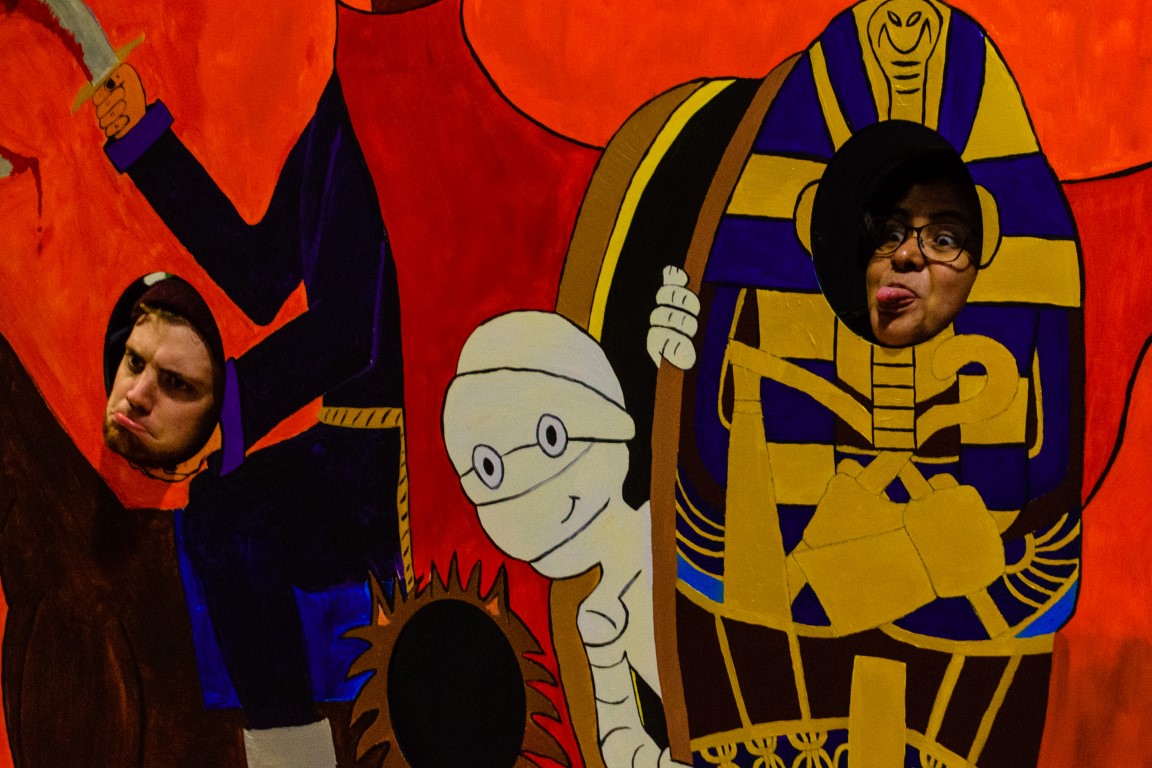
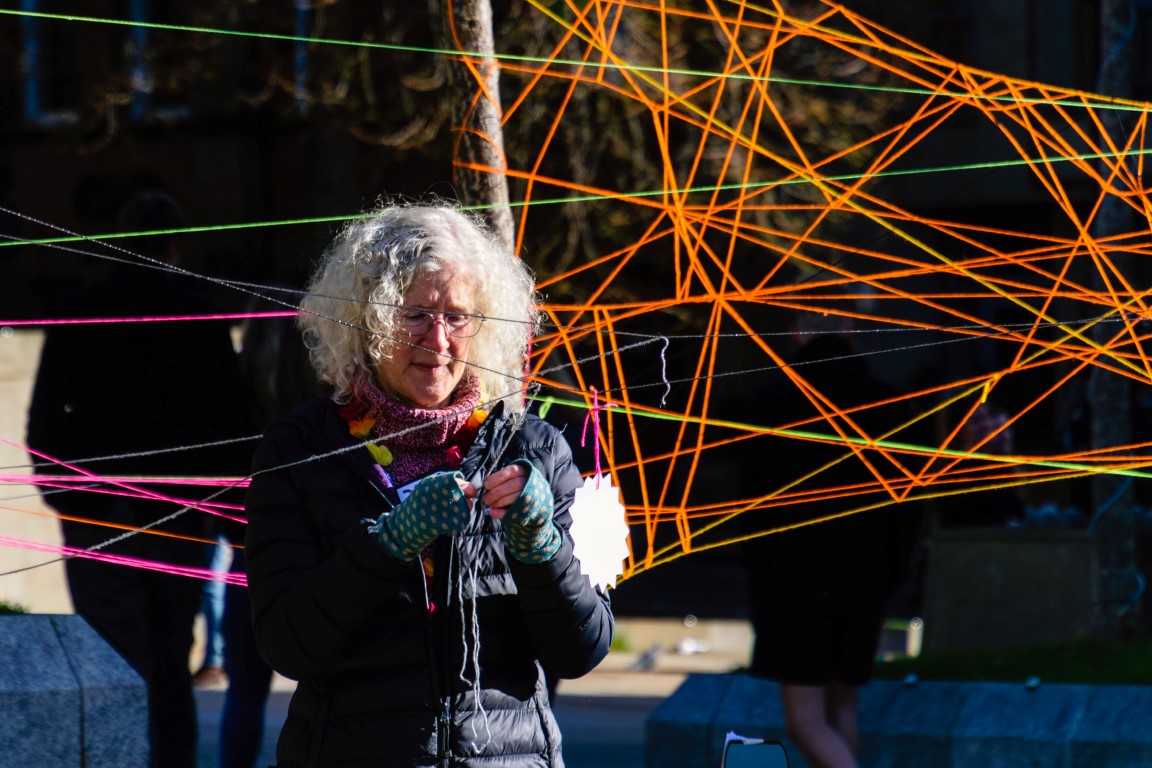
During CounterPlay in Leeds, I saw this flourish. Nobody wanted to tell anyone that this or that was the right way to play, but lots of wildly different invitations presented themselves. We greeted each other playfully. We spend a long time decorating nametags that were pretty or silly or both. We transported colorful feathers by blowing them from hand to hand. We made so many funny noises and gestures. We played with recorded sound loops. We made the slimiest slime. We made beautiful woolen spider webs between trees. We “flocked” and jumped around. We made new “play-laws” for Leeds to encourage play in public. We dressed up in cardboard. We had a fierce “tug of war” outside.
All of this amounts to a wonderful demonstration of the diversity of play.
Imagination
Play is a catalyst of imagination, because imagination is required to keep play evolving and moving in new, surprising directions. Imagination keeps play alive and vice versa.
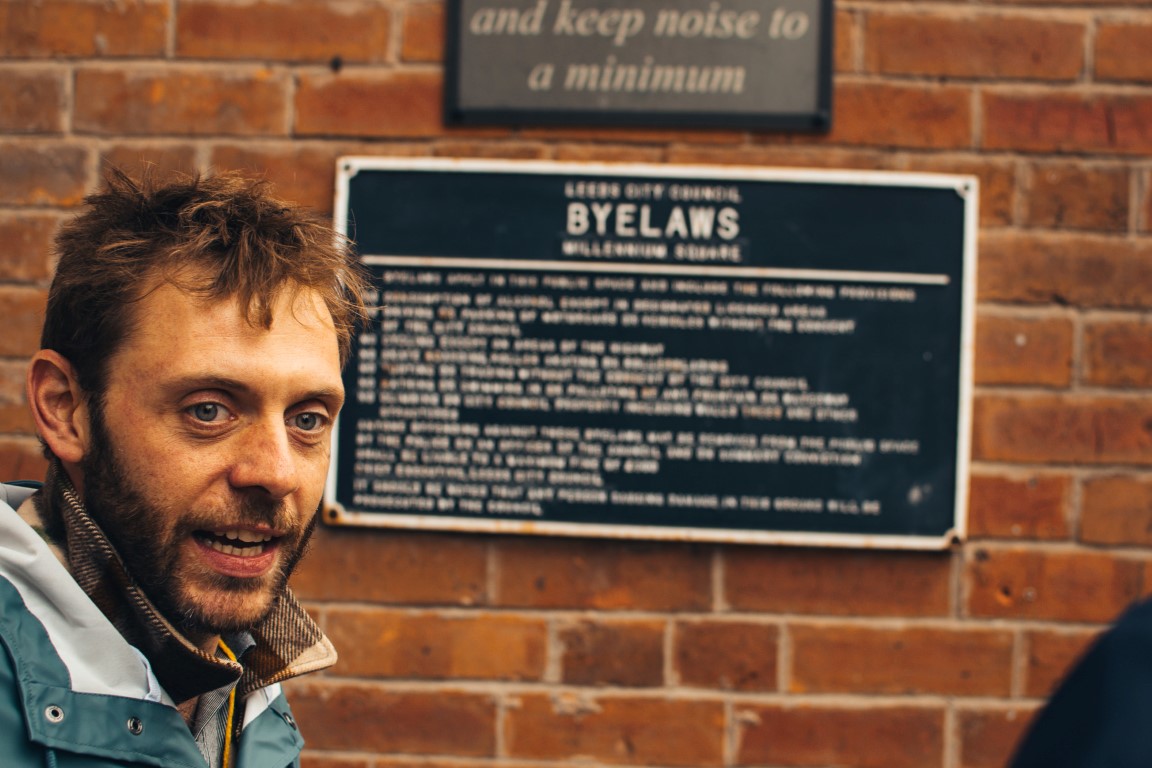
Guided by Malcolm Hamilton of Mufti Games, we went out and explored the urban space around the museum, where we found some pretty sad by-laws telling us all the things we couldn’t do:
Enthused by play, we quickly we imagined a different world where by-laws became playlaws, and instead of telling you what you’re not allowed to do, we started listing stuff you had to do:
“Don’t walk on the cracks. Walk like a bird. Avoid the lava. Point to an owl. Shake hands with someone. Don’t slip on the banana skin. Walk backwards. Jump! Spin!”
When someone walked by, we invited them to play and cheered them on when they chose to participate. Many people did, often with a combination of surprise and joy. “What is this? Am I allowed to play here?”
Even this somewhat serious-looking guy, who turned out to get more involved than anyone else. Apparently, it was his birthday and our little silly intervention made his day.
Inclusiveness
I always insist that play shouldn’t be restricted to any one group in society (like, say, children), but should rather be expanded to include all of us. It doesn’t matter if we’re young or old, if we’re male of female or something else, if we’re physically strong or less so. None of that is of any consequence, because none of us should be forced to live a playless life.
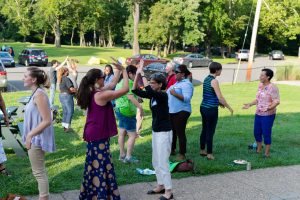
I don’t know the age of any of the participants, and it didn’t matter one bit. There were a bunch of families with small kids, some of whom stayed for a very long time, so immersed in play that they apparently couldn’t leave. Sometimes we were playing alongside each other, sometimes everyone came together across generations in joyous silliness like this round of human bowling:
Playing with other people, we develop a shared interest in keeping the play alive and we have a shared responsibility for this. This brings to the fore a certain kind of generosity, where we care less about our personal needs and more about contributing to the shared experience. We stretch a little bit more, take a few additional steps towards the other, trying to do and be a little bit better for the greater good.
Drawing on Anthea Moys’ brilliant performance at CounterPlay ‘17, Ben Ross had us “flocking” all over the place and it was a beautiful:
It’s a simple “game”, inspired by flocking birds, where everyone follows the leader of the flock. Whenever the leader turns , the entire flock turns and whoever is in front becomes the new leader.
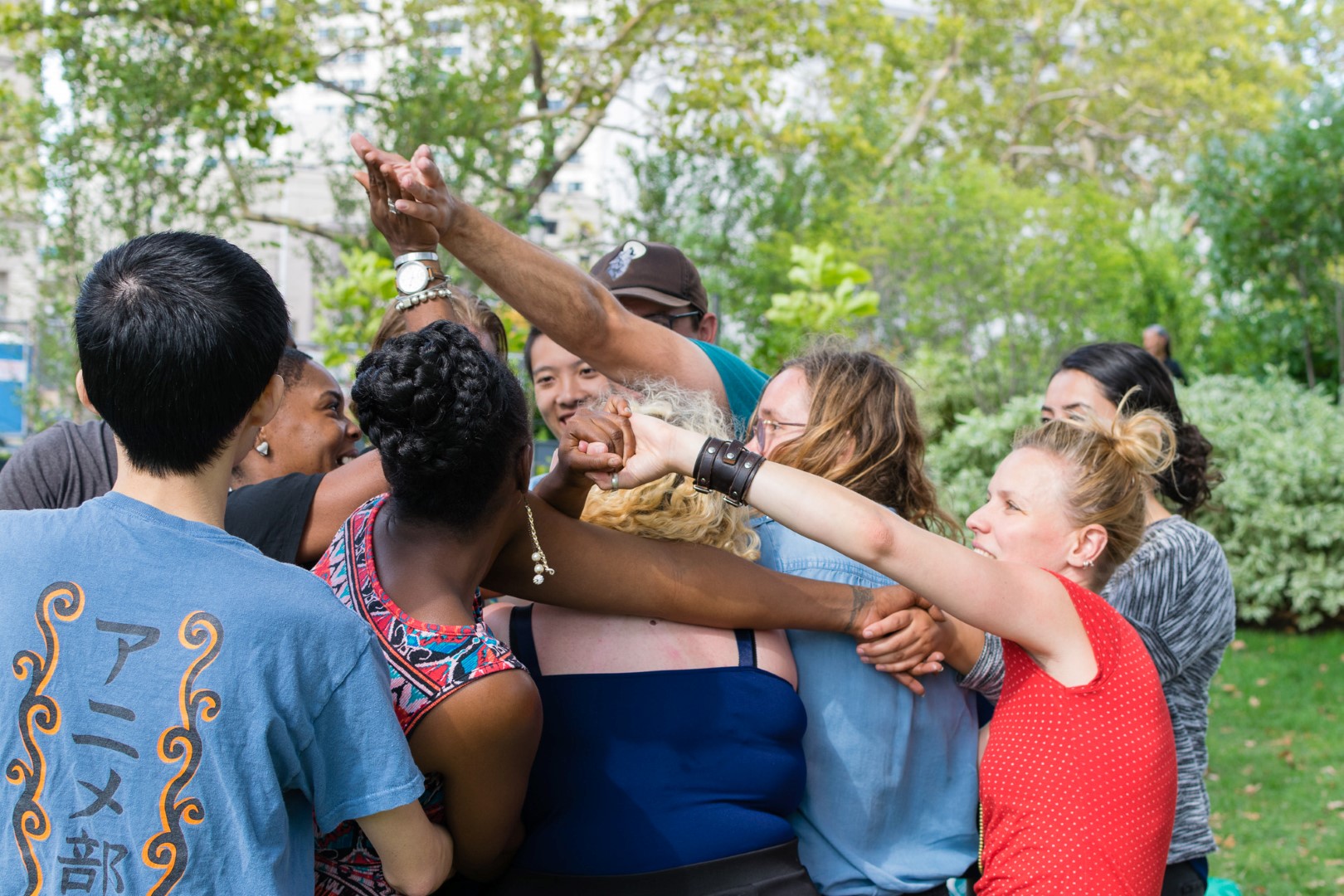
What’s remarkable about flocking is how quickly you start to feel like an (somewhat) cohesive organism, and you take it upon you to extend the experience. Generosity in action.
Permission
During the weekend, we kept coming back to the question of “permission”. How do we know if we have permission to play? Who can grant that permission? Is it ours for the taking? Maybe we can collectively, as a community, bestow the permission on each other?
While it might seem a trivial matter – playing is generally not prohibited – it actually appears to be holding us back more often than you’d think. We have grown accustomed to not playing and we need someone to renew our invitation.
This issue becomes even more evident when we don’t always know who owns . Due to what has been labelled “the insidious creep of pseudo-public space”, public space is longer always public, further blurring the actual ownership and the permissions we citizens might have. When some of the organisers started making woolen spider webs, a woman and her son joined them. It was only afterwards she learned that no official permission had been given, which made her quite surprised that we’d dare do it all.
We need to renegotiate the rules of engagement, reclaiming our permission to play in public!
In the next post, I’ll explore some of the actionable ideas that emerged during the weekend, so we can keep the playful spirit spreading.
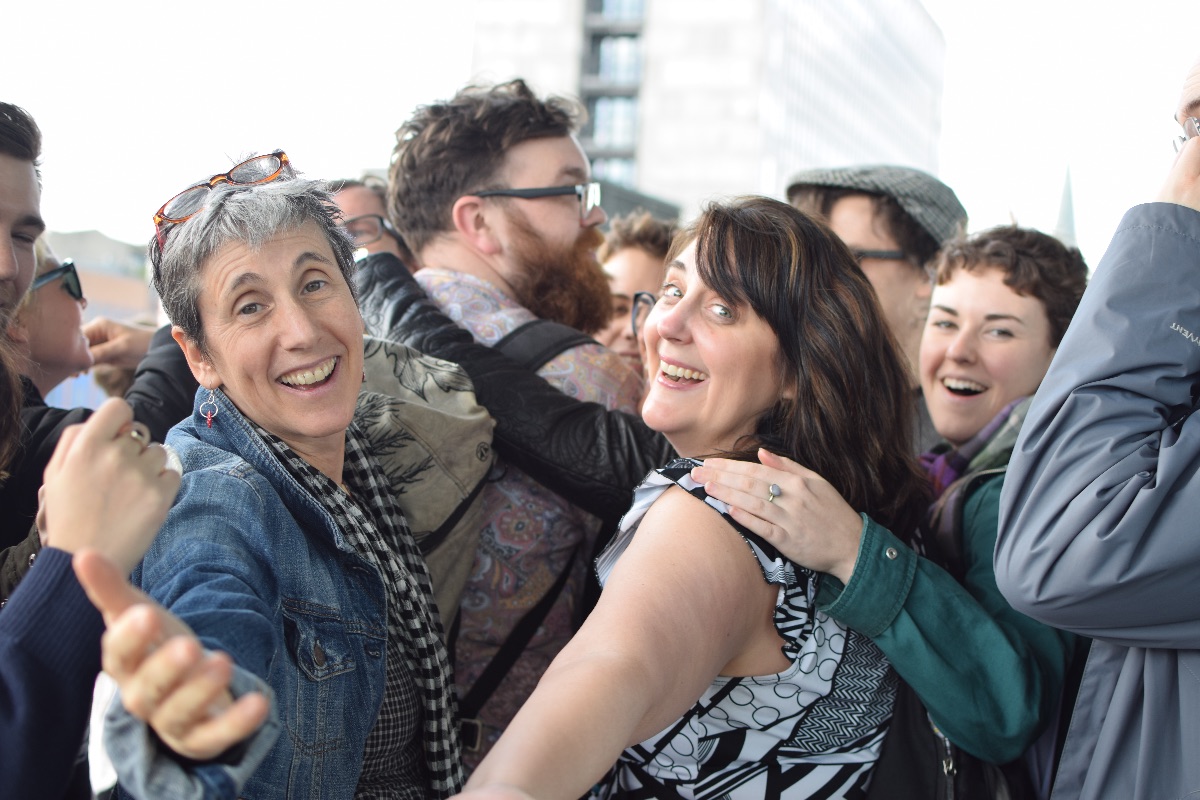
As I’m making my way home from my first ever visit to Leeds, I’m in this weird state of excitement and exhaustion that you often experience after a weekend well played. Yeah, I’m tired, but that is far overshadowed by an even stronger sense of hope, belonging, confidence and joy.
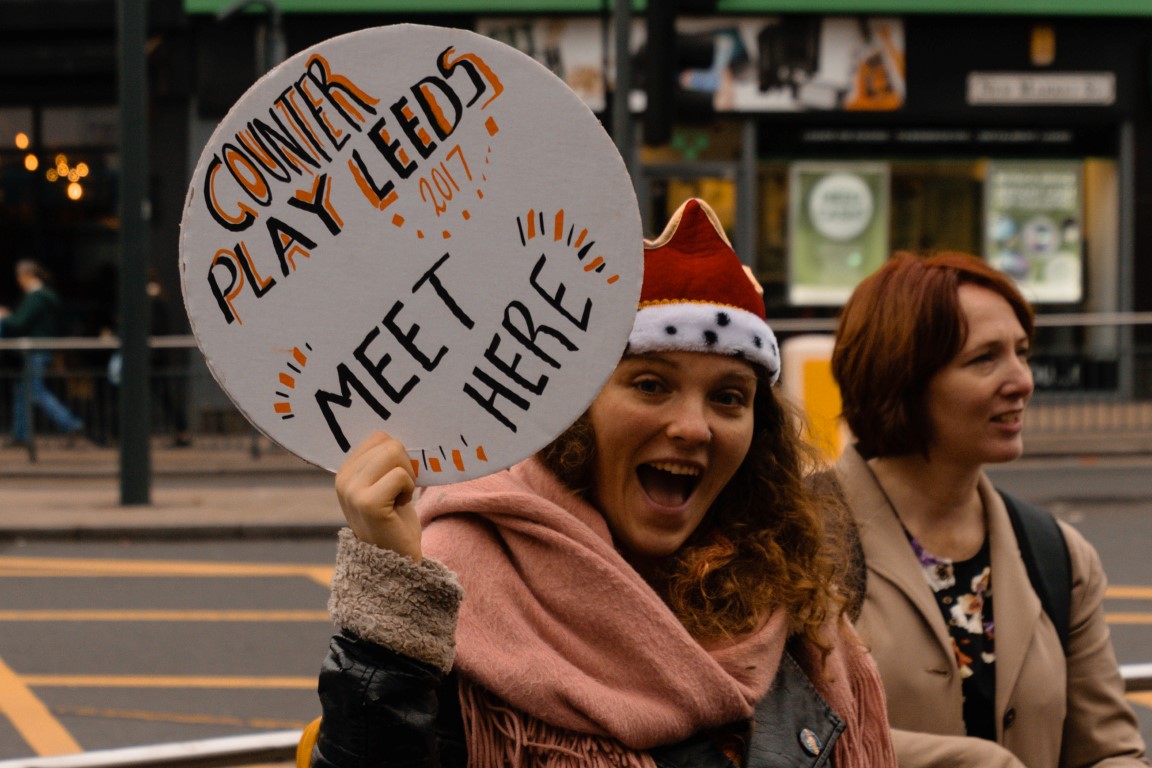
My reason for going to Leeds was a truly joyous, if slightly humbling, one: I was invited over to participate in the first ever CounterPlay “satellite” festival – CounterPlay Leeds.
HOW COOL IS THAT?
When I started working on the CounterPlay festival a handful of years ago, I always wanted it to be more than just a play festival in Aarhus, Denmark. I wanted the underlying ideas to spread, to bring play into new contexts and, in turn, to create a more playful society. More than anything, I hoped we could cultivate a community that would thrive and grow, transcending borders and boundaries, inviting an increasing number of people to play along. There’s a certain vulnerability in expecting this much from strangers, because what if it falls flat? Luckily, we’ve had so many incredible contributions coming from the play community, and the enthusiasm and dedication has far surpassed our wildest expectations. It seems like we have set something in motion that is not about to stop moving anytime soon and I’m beyond thrilled.
Thus, when my long-time Twitter friend Emma Bearman, who’s behind the wonderful “Playful Anywhere” in Leeds, suggested running a CounterPlay event in Leeds, I jumped with joy. YES! While the stars haven’t yet been aligned for bringing Emma over to CounterPlay, we’ve had many, many wonderful conversations on Twitter and just having the opportunity to carry on outside of social media was enough for me to head over to Leeds. Emma had teamed up with an amazing local group (including Robbie Foulston, Sophie Howell, Becky Sumerling, Jessica Penrose and Mel Taylor), and organised a wonderful event that oozed of playfulness. A special thank also goes to Leeds 2023 for supporting my visit and Leeds City Museum for hosting the event – what a lovely place!
It was supposed to be an informal “open space” for kids and adults alike, where we would be playing, talking and reimagining the playful city along the way. We had some conversations and I described the core values of CounterPlay, but other than that, they just ran with it. When I left for Leeds, I basically didn’t know what was going to happen, which was a new and quite exhilarating. I’m sure I could get used to that!
I wanted to open the event with a talk about my experiences and reflections on starting and running CounterPlay. I intended to build a bridge back to the festival, framing the current event and hopefully inspiring people to not just play, but also to think and talk about play. While it had too many words in it, at least some of those words seem really, really important to me.
I tried to convey the most important thing about CounterPlay, namely the playful atmosphere that makes it a safe space, where adults dare to be silly; where people open up and strangers connect; where the realm of the possible is expanded; where we engage in deep conversations that truly matters; where we are all less afraid; where we see play as a celebration of freedom and where participants perform a playful takeover because they feel real ownership.
I also hoped to describe how we insist that play is equally important for all of us, no matter our age or place in society, and that play is both an activity, an attitude and a paradigm.
Play is JOY / FREEDOM / LOVE.
All my words really boils down to one thing: the mere existence of play in our lives will make our lives better. Happiness are closely tied to the courage and capacity to play. Sever that tie and your odds of living happily ever after are reduced drastically. While I fully acknowledge that play has many, many extremely valuable side-effects, they are always less important than play itself. Furthermore, they are entirely dependant on allowing play the freedom to flourish. I find myself repeating these things, but just like when we’re playing, the repetions are part of the sense-making, part of the fun.
I paid a little extra attention to one particular side-effect, namely our imagination. When we play, our imagination is running on rocket fuel, and it becomes an essential catalyst of play, exploring as it is all the possible directions, ideas and actions.
Not only that, when we’re playing, we also develop our capacity to imagine how our cities, our societies, our relationships to other people and our lives could be different. There’s a beautiful quote by philosopher Martha Nussbaum in her book “Not For Profit” that encapsulates the human connection of play:
“When we meet in society, if we have not learned to see both self and other in that way, imagining in one another [] thought and emotion, democracy is bound to fail, because democracy is built upon respect and concern, and these in turn are built upon the ability to see other people as human beings, not simply as objects”
This is at the heart of play: seeing each other as human beings. Oh, how the weekend captured and demonstrated these things beautifully, so beautifully.
Plastic bags were sticked around their heads with different colors of tapes, some of them had capes behind their back. They were the participants of the workshop “Urban Consensus Play” by Jakob la Cour during the CounterPlay Festival ‘17. They were asked to challenge the consensus of the ownership of public space by wearing DIY masks and invading the city as if they owned the space. They provoked the passersby, they broke the rules and norms; Meanwhile, the “normal” citizens just stared at them weirdly and awkwardly. This little social experience challenges the boundary of ownership. Why did people stare at the participants and feel uncomfortable? Is it because they are acting abnormal compared to what people ought to act in the society?
Nowadays, people are too busy looking at their smartphones and they tend to take their city for granted. As a matter of fact, they forget to be playful in their busy everyday life. This issue was brought to focus at the “Playful City Roundtable” held during CounterPlay Festival ‘17.
Play is a fundamental part of being human – it is a form of expression. Therefore, we should break the norm and make our city into a playful city.
To make our city a playful city, the first step is to get people involved. When we live together with other people in a city, we have the responsibility to make room for everyone to live in it. For example, we have the responsibility to park our bikes so that they do not disturb others; We have the responsibility to buy bus tickets when we take the bus. When we have responsibility, we also have ownership of the public spaces in the city. For instance, we can sit on the bench in a park freely without permission; We can take a photo of the beautiful sunset near the harbour without license. These activities can be done because we have ownership of our own city. Yet, people tend to take these small incidents for granted and do not realise that they have responsibility and ownership of their own city. Thus, they may not be as involved as we imagined.
To maintain the engagement of citizens’ ownership of their city, we should increase their interest in the city. In the roundtable, it was mentioned that the municipality could invite citizens to participate in projects and let them become part of these projects. By this, citizens will feel more engaged in the facilities in the city and will be willing to co-create and transform the space they live in.
When people start having a sense of engagement and ownership of the city, we can start planning the future for a more playful city. Most cities already have several playgrounds around, which encourage both children and adults to enjoy each other’s company and get the best of it through playing. Other than playgrounds, we, as citizens, can intervene and challenge the surroundings and institutions by the power of play. Slow down and notice the small details around us. Things are already there, we tend to pay less attention to them in our busy digitally-saturated everyday life.
Look around instead of looking at your phone!
In addition, the municipality may consider building changeable or transient installations around the city with multifunctional features. Features can be a combination of the field of health and play, or a creative and sustainable installation with learning purpose behind.
There are always two sides to a story, though, and there will often be a downside of all these new ideas and plans to make a city more playful. There will always be rules that stop us and hold us back from play, which will affect the development of a playful city. Besides, people take these activities and installations differently, both positively and negatively. This leads to the question of tolerance, where we have to find the balance between freedom and system. At the same time, budget and responsibility also play a major role in the development of playful city.
As a whole, to create and develop a playful city is an ongoing process, which involves different stakeholders from all segments, including the people who live in the city.
Sometimes, we simply need to be provocative and use the power of play to challenge the norms around us.
In the next few posts here on the blog, we’ll share some of the perspectives on the playful city that emerged at the recent CounterPlay festival in Leeds, UK.
When you play, things change, the world changes, and you change.
The same goes, obviously, for CounterPlay.
Over the course of four festivals, we have changed immensely. We have gotten further than I could ever have hoped for, and I believe we have made important contributions to the play community. From a modest beginning, CounterPlay has evolved into what in my (heavily biased, yes) opinion is one of the most ambitious play festivals of its kind with at least a handful of unique traits:
We insist on play: our main focus is always on play, not the perceived side effects. The side effects can be important, but if we start focusing too much on them, we lose sight of play.
We invite play, conversation & reflection: to understand play, you have to play, but it’s also not enough to just play, you need to talk and think about it. That balance is a delicate one, but essential to keep experimenting with.
We encourage participation: play invites openness and participation, and we maintain that everybody must be able to really participate in shaping the festival at all times.
We see play as being meaningful and important for anyone, everywhere: our approach to play is holistic and emcompasses all of society and all of life (“We don’t stop playing because we grow old; we grow old because we stop playing”).
We embrace the ambiguity of play: the old adage “the more you know, the more you know you don’t know” really holds true with play, as it’s an immensely ambiguous phenomenon, and we need to embrace the fact that none of us truly understands play.
None of these are unique for play events, but I believe that the combination of them are. It seems that this particular approach has been successful in cultivating a very special atmosphere:
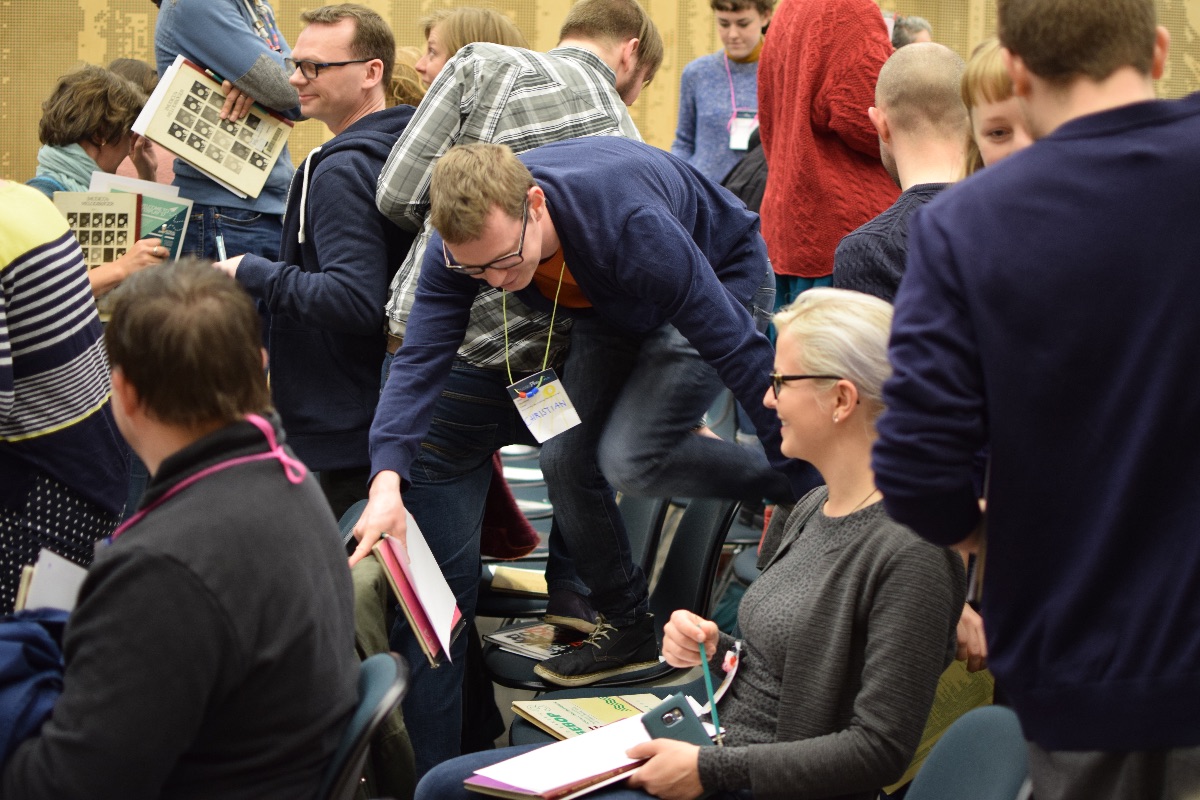
We have been surprised time and again by the tremendous courage of our participants, who overcome whatever initial reservations and anxiety they may have had. Remember, this is strangers stepping into an unknown space where many unexpected and maybe even intimidating things might happen. In the best moments, the festival cultivates a very special, playful atmosphere, where everyone come together as a community. These situations feel truly magical, as the usual barriers and masks fall away, people open up to each other and the world, showing a remarkable trust in strangers. They are present in ways you rarely see, committed and sincere. In play, it becomes deeply personal.
I am proud of what we have achieved, and our dedication to continue this work is bigger than ever, but we have realised that to do so, we need to change even more.
Here’s the biggest change:
Effective immediately, we will turn our main event, the CounterPlay festival in Aarhus, Denmark, into a bi-annual event, meaning it will be back in 2019.
This is by no means a signal that we’re slowing down or lowering our ambitions – on the contrary!
The main reasons for this decision is that we need more time to develop the festival, and this has proven quite challenging when there’s always less than a year to the next event. It is our intention to stay around for a very long time, and for that to happen, we need stronger roots. We also wish to engage in more initiatives that is either borne out of or leads up to the festival, so we can develop new activities and formats together with the play community.
Furthermore, we realise that since part of our community keeps coming back (THANK YOU!), it might be a bit much to go to Aarhus every year, whereas every other year is probably more feasible.
While we keep improving the festival, we also wish to contribute to the play community in other ways, and we are very eager to create more, smaller events between the festivals for greater continuity.
We have take the initiative to establish a national Danish “play think tank”, which will surely inform much of our work going forward.
CounterPlay is slowly spreading to other cities and countries, beginning with an event in Leeds (together with Playful Anywhere) at the end of October.
We are working with Aalborg University and other organizations in Denmark to bring the atmosphere from CounterPlay to new contexts.
We have rebooted the #cplaychat, a bi-weekly Twitter based chat about play.
We seek to experiment with more materials about play, encouraging play, including more consistent blogging, playful initiatives on social media, books and more.
[/su_list]
In short, we’re getting ready to do more to help play thrive.
In addition to this, we are always open to suggestions, ideas, conversations and partnerships. If you share our ambition to fight for play, don’t hesitate to comment or get in touch.
A while back, I was invited to train a group of instructors, who would be leading six play camps across branches of the Free Library of Philadelphia. “Teach them about play”, my friend Joel requested, and of course I immediately said yes. The training week took place from August 7-10, and it was so much FUN! What a great group of people, who were incredibly eager to play and to create great spaces for kids to play.
Playful Training Week
I aimed for a playful training week, that would mirror the principles of play, we use for designing CounterPlay. The goal was that the instructors would develop:
A deeper understanding of the nature of play
A shared understanding of “play literacy”
An appreciation of the diversity of play and experience with different forms of play (nature play, dramatic play,
A basic skillset to design for play in practice
The purpose of the camps were revolving around a notion of “play literacy”, to simply allow the kids to play and to improve their abilities to play well, alone and with each other. It was quite a privilege to be able to focus on “just playing”, as this is where the magic really happens.
You can read more about the plan here, but we moved between many different formats and types of activities (short presentations, discussions, design challenges and play sessions) to understand play from many different perspectives. I really wanted to demonstrate the diversity of play, to encourage them be open to the ways the kids would want to play, and to make them feel confident in their own creativity and capacity to design and change games and play activities. We played a lot, everybody started sharing with the group, and the designed many, many brilliant activities, as I tried to provide them with some guidelines and things to consider:
Always consider who will be playing in the space. How old are they? What is their background? How many will be playing at any one time?
Try to accommodate for many different ways of playing. Create a range of invitations and make them open.
Don’t make the space too safe. Allowing kids to play with risk is important!
Include “loose parts”: things that can be moved, used and combined in many different ways.
Be prepared to adjust the space when people start playing in it. Observe and listen to the players, they’ll be the experts in what works and what is fun. Trust the players!
It was tremendous fun, the group were so friendly and passionate, and I think we got quite far in just four days, that flew by, really. We were playing most of the time, after all.
Play Jam at Smith Memorial Playground and Playhouse
While I was in Philly, I also got to host a small “play jam” at the wonderful Smith Memorial Playground and Playhouse. It was a beautiful summer afternoon/evening, and a nice crowd showed up, ready to play!
We started by playing the not-that-famous “Danish Clapping Game“, before I asked everyone to think about and share their “favorite play memory” (what is yours?). I talked a little bit about why I find play to be so incredibly important for the good life, also and not least for adults (here’s my presentation).
It’s always a delicate balance, where I feel it’s important to frame my way of thinking about play, but I’m also quite eager to get people playing before they fall asleep. It seems like we struck a decent balance here, and you really sense the energy: these people came to play!
I challenged the participants to design a new form of play with the theme “change” – in 30 minutes! I brought some balloons, soap bubbles and chalk, while the brilliant Smith people had a much larger collection of “loose parts“. People could use whatever they wanted as “props” for their play activity – including everything on the fantastic playground!
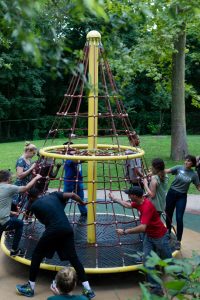
Just as I had hoped, all the groups immediately embarked on an exploration of the loose parts and (not least!) the playground and the famous old wooden slide.
It was amazing to see how they all just started playing, and then ideas and concepts started growing out of their shared enjoyment:
“This is fun, but what if we do this?”
“Yeah, and then we can use these balloons…”
“Oh, yes, and if we all get on to this thing that goes round and round, then we have to pop the balloon…”
“…with spaghetti?!”
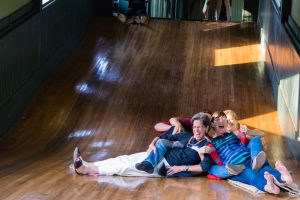
I was completely blown away and deeply impressed by their willingness to play, be silly, experiment, be open to each other and actually come up with some pretty hilarious concepts along the way! There was the “pop a balloon with spaghetti” game, the “ride the slide in a big bunch of people”, a haunted house, tag on a climbing…thing, a fantastic contraption, a soap bubble blowing game and a group, who were just looking for an excuse to hit each other with balloons.
It was completely impossible to bring everyone back to present their ideas, since they just wanted to keep on playing.
I *loved* it!
The ideas were great, but the most important thing was the process, the exerimenting, designing and playing, the confidence that designing play activities are not really that hard and that everyone can do it.
All in all, I enjoyed the trip to Philadelphia immensely, and am really grateful for the opportunity to meet and work with so many brilliant people; I can’t wait to find an excuse to go back!
In this post, I try to capture the essence of CounterPlay, the principles underlying the festival and the connection to play. Part of it is a description of what we have been doing since the beginning, while part of it remains more of an ideal for our future work. There is always potential for a deeper understanding of play and a closer link between the festival, the way we organise it and the nature of play.
The Festival
From the outset, CounterPlay exists only because we simply believe play is important throughout the lifespan, for all of us, and that playful people are better equipped to live good lives in this messy, chaotic world.
The CounterPlay festival cultivates an international play community to explore the nature of play and to support play all over society with our main pillars being “Playful Learning”, “Playful Working” and “Playful Living”. We are proud of what we have achieved, and we firmly believe that we have made several unique contributions to the field of play. The festival is pushing the boundaries of our understanding of play, and we are expanding the perception of who can play when and where. It has become an internationally renowned event with a thriving community, who are both shaping the festival and spreading traces of play around the world.
We have been surprised time and again by the tremendous courage of our participants, who overcome whatever initial reservations and anxiety they may have had. Remember, this is strangers stepping into an unknown space where many unexpected and maybe even intimidating things might happen. In the best moments, the festival cultivates a very special, playful atmosphere, where everyone come together as a community. These situations feel truly magical, as the usual barriers and masks fall away, people open up to each other and the world, showing a remarkable trust in strangers. They are present in ways you rarely see, committed and sincere. In play, it becomes deeply personal.
In these moments, the festival is a safe space where everyone can participate and contribute, develop a sense of ownership, where all kinds of thoughts, ideas and experiments are welcomed and elaborated upon, where people say “yes, and…”, where the silly is completely intertwined with the serious, the personal, the deeply emotional. It can be hilarious, sure, but it always has a serious side to it, and this seems to resonate profoundly.
It demonstrates how play and a playful mindset enables new ways of being and living together. When a group of people join each other in a playful atmosphere, the realm of the possible expands drastically. More things can happen, simply because people are more open, say yes to more, unleash their imagination, show a greater sense of empathy, are more courageous and willing to take risks.
“CounterPlay is one of the few public events that brings together people from widely divergent disciplines, and yet are united by their devotion to making the world a little more playful. Bringing them together like this, to play and talk and share each other’s vision, creates an unforgettably playful, creative and productive environment and helps all of them to find a larger and more inclusive perspective on their work.”
“I have no idea what happened those three days, but within the first five minutes strangers hugged me, crawled over me and I loved it. Counterplay has the unique ability to create a safe atmosphere immediately and has the right balance between theory and practice. I am a fan for life!”
“What inspired me most was the camaraderie, the ease of conversation and exchange as if we had all known each other for decades, the lack of pretension anywhere.”
“I was inspired by the variety of people – ages, nationalities, interests, approaches – for whom playfulness and play are so key. There was such a powerful sense of a global community and a growing movement. I brought back renewed energy and enthusiasm and lots of happy memories.”
We intend to let the values of play be our only point of orientation, so all our design principles grow out of our understanding of play. To design for a playful atmosphere, the entire process must mirror the principles and values of play, creating a safe space for people to explore the meaning of play and playfulness together.
Insist on play
There’s this constant discussion and distinction in the field of play: play for the sake of play, or play for the sake of something outside of play. Either you think play is important because you think play is important, or you see play as valuable because it can lead to other perceived benefits. While both positions are perfectly legitimate, we find that play only ever really manifests as play when it is all about the here and the now, the playful moment. If you focus on something outside play, you dismiss the true purpose of play: play itself. If you direct and control it too much, it will lose it’s potential, the magic will disappear and it will become something else entirely. To us, the primary focus is play and the playful approach to life.
Cultivate a play community
Our attention must always go further than the festival itself to include the play community, which is the beating heart of the festival. Cultivating a diverse play community where people are actively participating to explore and spread play is probably our best bet to foster a strong movement towards a more playful world. When we know for certain that we are not alone and that other people feel the same urge to be playful, then we can easier muster the courage that is necessary to challenge the non-playful structures around us.
Seeing the play community as a whole is relevant, as it transcends the limitations of any one person or organization, who can only do so much to improve the conditions for play to thrive in society. As a global community, on the other hand, we have the potential and power to utterly transform the role of play in the world.
When we play with each other, we stop hiding who we really are. Play invites and encourages a certain kind of openness, sincerity and honesty, and we strive to live up to those ideals when organising the festival. We don’t have hidden agendas or dark secrets, and we try to share openly, inviting the community right into the engine room.
Invite participation throughout
When we play, we become participants, as we engage in an ongoing negotiation with the other players about purpose, rules and roles. Players are participants with agency to shape the course of the experience, and we insist the same must be true for CounterPlay. We always listen to suggestions on every level, from the big visions and hard questions to specific activities. This continues during the festival, where we always invite everybody to “hack and steal the festival”:
“Remember that the more you participate, the more you put yourself into play, the more you will bring home with you. The festival should inspire you to be active; to be present in the moment; to let your guard down and open up towards the other participants and to new thoughts and ideas; to take yourself less seriously; to set your imagination free; to dare to be joyful and hopeful. To make this possible, we all have to do our best. We all have to stand on our toes, to bend towards each other. We’ve got a lot of things scheduled for you, but please feel free to break the rules, to hack the program and take over the festival. It’s yours to play with.”
This makes it impossible for us to accurately define the potential outcomes for our participants, and we merely create a framework where people can explore the nature of play. This clearly raises the bar for what we expect from our participants, as we encourage them to really step up, and to do and be their best. While this can probably seem rather intimidating, we believe it is the only way the festival can be truly meaningful for everyone.
Embrace the ambiguity of play
Definitions possess a magnetic allure, pretending to convey complex phenomena in simple, clear-cut ways, but they always simplify, and when it comes to play, the trade-off is quite frankly not worth it. As a consequence, we embrace play as a complex phenomenon full of (beautiful!) ambiguity that effectively resist any one definition. Instead of trying to find the “one true” meaning of play, we invite as many perspectives and meanings as possible; from all over society, and from research as well as practice. There should be no privileged position for any one person or position, and we must keep reminding ourselves that we don’t know and will never know exactly what play is, what it looks like or how it feels.
Play is mysterious, and any attempt to define it and tie it down tends to be met with resistance. At CounterPlay I saw the participants handling this mystery with respect. We prodded at play, massaged the edges to try to find out what we could about its shape, but resisted the urge to go at it with a hammer in desperation to find out what’s inside. This gentle approach felt the right one to me – I was welcomed by other play-explorers and invited to be vulnerable, to share, to experiment, and to do all this with heart. – The Flying Raccoon
Play can lead to the most unrestrained, rambunctious and silly situations, where people are quite literally rolling on the floor laughing or smiling on the inside. These aspects of play should absolutely be nurtured and welcomed, since they bring with them incredible energy and joy. At the same time, we always seek out the back and forth movement between the silly and the serious, as we wish to create a space for playing as well as thinking and talking about play. Due to the immense ambiguity and diversity of play, there is no real contradiction here. Play is more often than not taken very seriously by those playing, and it easily, effortlessly accommodates for more introspective and reflective play practices.
Design for surprises
Play can be completely unpredictable, as we interact with each other, the world and our own thoughts and bodies in surprising ways. Sometimes we’re moving around, touching each other, exploring the physical, tangible world, while on other occasions, the surprises come from thoughts and ideas colliding, reshaping each other, merging. In either case, you never know exactly where it takes you, and the same approach is embedded in the festival. There’s no sense in hoping to control everything, so we always try to embrace the unexpected, and consider it a success whenever something happens that we hadn’t planned for or even fully understand.
While there a moments during each festival that truly feels like magic, it is simply a matter of choice and design. If we can create a space where this atmosphere thrives at CounterPlay, then it should be possible to do the same all over society: in schools and universities, libraries, museums, urban spaces, private companies and more. We are always encouraging our participants to reflect upon this and make an effort to cultivate a similar culture in their workplace and daily life. With small steps, anyone can cause real change.
It was always our intention reach outside the festival and to increasingly support the spread of playfulness everywhere. Do you want to learn from our experiences and maybe even organise your own local CounterPlay festival?
Årets CounterPlay festival er nu lidt på afstand, men vi er stadig opløftede og fyldt med energi. Tænk sig, at man kan få legende mennesker fra hele verden til at komme til Aarhus, dele erfaringer, åbne op, sætte sig selv på spil og bare lege med hinanden. Paraderne falder bort, humøret ryger i vejret, og vi kommer forbavsende langt sammen på kort tid. Det lykkes at overskride alle de sædvanlige barrierer – fordi vi leger sammen.
Counterplay has the unique ability to create a safe atmosphere immediately and has the right balance between theory and practice. I am a fan for life!
Festivalen er en vild, kaotisk og mangfoldig oplevelse, der nok kan virke overvældende og måske lidt skræmmende. Vi lader festivalen spejle sig i legen, hvor meget kan lade sig gøre, hvor der ikke altid er styr på alting, og hvor man ikke nødvendigvis ved hvor man ender. Vi betragter mest af alt festivalen som en hyldest til legen, en kærlighedserklæring til den legende tilgang til livet. Den er også et laboratorium, hvor vi, i en god legestemning, undersøger hvad det egentlig er, legen kan.Vi vil skabe et univers, hvor det er legens principper, der definerer hvordan vi er sammen. Hvilke muligheder får vi, hvis vi er mere legende, når vi lærer, arbejder og lever? Hvorfor vokser åbenheden, nysgerrigheden, venligheden, fantasien, kreativiteten, modet, respekten, forståelsen, energien, begejstringen og hvad betyder det?
Counterplay ’17 was unlike any conference I’ve ever been to; exciting, interactive, full of interesting ideas and people and above all playful. It demonstrated that we can do things differently!
Nu har vi afholdt festivalen fire gange, og vi er kommet langt. Vi har lavet et unikt og anerkendt legefællesskab, der kan noget særligt, og den udvikling vil vi fortsætte – så længe nogen vil lege med. Vi er dog ikke blinde for, at en festival som denne også har en række begrænsninger: den er stærkt afgrænset i tid og rum, udelukker mange (bl.a. pga. sprog, ambitionsniveau m.m.), og kan ikke i sig selv understøtte (men måske igangsætte) større forandringer.
Det har aldrig været meningen, at CounterPlay “bare” skulle være en festival, men derimod en katalysator for mere leg. Vi tror inderligt på, at vi kan bringe nogle festivalens principper, oplevelser og stemninger i spil i andre dele af samfundet. Festivalen er bare én mulig ramme om leg, én legeplads blandt mange.
Derfor var det umådeligt opløftende at erfare, at flere end nogensinde efterspørger mere leg. Mange deltagere efterlyste aktiviteter i løbet af året, fra ganske enkelt at mødes til debatter, workshops, flere udgivelser, podcasts og meget mere. Vi har overvejet og drøftet med flere at etablere en national legetænketank, og jeg kunne godt tænke mig at lave et aktivistisk projekt omkring legekultur – lige dele formidling (udgivelser, podcast, video m.m.) og interventioner.
Vi er som udgangspunkt åbne for alt, der kan give legen bedre vilkår. Leg gør vores liv og samfund bedre, og behovet synes at være større end nogensinde.
CounterPlay ‘17 is over, it’s been several days, and I’m only slowly catching my breath. It was a wild and crazy ride, and all the impressions still need more time to settle. We considered this to be the most ambitious festival yet, and we expected it to be playful and chaotic, but we honestly had no idea how it would be received. I mean, how could we? It’s all so dependant on the community and the willingness to participate. We insist that we must organise the festival in ways that mirrors the openness of play, which inevitably also leads to unpredictable results, or what Gwen Gordon so brilliantly labelled “magnificent mayhem” (a new tagline, maybe?):
In the situation above, I honestly didn’t have a clue what was going on, but it was glorious. I loved it and it captured so much of what we could ever hope to achieve.
At this point, the community clearly felt like a safe space, where everyone could participate and contribute, where all kinds of thoughts, ideas and experiments would be welcomed and elaborated upon, where the silly had been completely intertwined with the serious, the personal, the deeply emotional. It was hilarious, sure, but it was much more than that, and it seemed to resonate profoundly.
I experienced many more of these situations, and I believe that we have shown how play and a playful mindset enables new ways of being and living together. When a group of people join each other in a playful atmosphere, the realm of the possible expands drastically. More things can happen, simply because people are more open, say yes to more, unleash their imagination, show a greater sense of empathy, are more courageous and willing to take risks – or in other words: people play along.
Throughout all this, it felt like more people than ever were eager to contribute to the continued expansion of the global play community. This is truly encouraging and heartwarming, as the purpose of CounterPlay has always been closely tied to the community. There was this one person, who said that she was deeply moved by realizing that we have agency and power to change the world simply by fighting for play together. This beautifully captures the essence of our ambitions, and perhaps the strongest sentiment I carry with me after the festival: the change we can cause together is significant:
Seeing the play community as a whole is relevant, as it transcends the limitations of any one person or organization, who can only do so much to improve the conditions for play to thrive in society. As a global community, on the other hand, we have the potential and power to utterly transform the role of play in the world.
My dizzy head is spinning with ideas, so many experiments I’d like to make, and adventures I want to embark upon with this community. It will take some time to fully crystallize, but a few things stand out already. They’re all revolving around the general suggestion that we need more activities throughout the year.
Local meetups & interventions – someone mentioned a sort of CounterPlayX (inspired by TEDx), where local “charters” build on what we have learned from the festival (I personally love the idea about CounterPlay as some sort of travelling circus).
Podcast – as a way to capture and share some longer conversations with people in the play community.
Online play forum – as a space for ongoing conversations about play in the community.
Publications – after making “The Power of Play – Voices from the Play Community”, I’d love to create more publications of all kinds.
It’s important to stress that these things can obviously only happen, if some of you are keen to play along (and most of it also requires us to secure additional funding).
For now, consider what you would like to do to create more opportunities for yourself and others to live a more playful life. If you have ideas, let me know in the comments.
Maybe you have heard us talk about the CounterPlay festival as a “prototype” of the playful society. I’d like to dive a little deeper into that idea, since it’s basically the most important reason for the festival to exist. It’s our BIG dream to contribute to a strong movement towards the playful society. There’s not an endpoint to this, of course – when is a society truly playful (enough)? It’s more of a guiding principle, a compass for our continued efforts. It reminds us that it’s never just about the festival (even now, when it steals most of our attention). There’s always something bigger, more substantial at stake here: society in it’s entirety. The point is that the festival should mirror the values and principles of play, not just in the content presented, but in the experiences, the atmosphere, the way you feel when you’re there. It should, essentially, be a prototype of the playful society, albeit on a much smaller scale.
What, then, characterises a playful society?
Participation
It’s a core tenet of play that in order to play, you participate, and participation “requires actual power and decision making to be put in the hands of those you expect to play along” (Play as Participation). This takes many forms, including the ongoing negotiation between players: what are we playing? What are the rules? The roles? The purpose? In a playful society, we are all participants, and we all have real power to shape the conditions for our shared lives together.
When we play, we’re present and open to the world and each other in a very unique way. We put ourself into play, so to speak, and we accept that our thoughts, ideas and assumptions challenged. We agree to step out of our “comfort zones”, to explore the unknown, and to embrace unpredictability.
Empathy
“When we play with other people – friends, family, colleagues or strangers – we share the responsibility, and we need to be present in the moment, right here, right now. You are open to the world, aware, listening, anticipating, embracing what the other person brings. This is rarely more visible than in the eyes of people playing with each other. The way they shine, the pure joy, this is as close to magic as it gets. In this sense, play becomes a demonstration of empathy, an exploration of being together in ways that respect us all. Play is a lesson in humanity, a gentle reminder of all the things we have in common across age groups, nationalities, religions, socio-cultural backgrounds and other differences that usually keep us apart.” (The togetherness of play)
Play opens up your mind and your imagination. You see the world in a different light, interpret things differently, and you refuse to simply adhere to common logic and assumptions. You’re not fully disconnected from the “real” world, but you bend and shape the world of play so it feels right. Anything can be anything, and even the most trivial objects or procedures can be endlessly thrilling. Playful people maintain the connection with their imagination, can always find another way, and thus refuse the widespread “politics of necessity”.
Joy
When we’re in that particular playful state of mind, engaging in playful play, we feel a deeply satisfying and pleasurable sense of joy. Play is joyful and we shouldn’t be afraid to fully embrace this feeling. Don’t misunderstand it as hedonism and don’t be afraid of what other people might think, it’s a vital component of the good life. You might argue that the joy of play is not real since it’s fleeting and not necessarily sustained for long outside play. You can and you should choose to savour these moments, but you can also make them a regular occurrence throughout your life by living playfully.
Hope
With so many terrible things happening, what we need more than anything is hope. Where are we, if we lose hope that the world could be different, that it could be better and more just? In play, there is always hope. With our spirits high, our imagination all fired up, and a strong sense of trust in the play community, we instill in each other the courage to hope. If your approach to life is playful, there is always hope, because you instinctly know that the situation could be different.
There’s much more to play than this, obviously, but these are important traits, which we aim to build into the festival. Our goal is that everyone feel that participation is real, that they allow themself to be more open and that others do the same, that we extend our empathy, sets our imagination free, and feels a deep sense of both joy and hope.
What’s worth noticing here is not that this happens at the festival, no, it’s that it can happen anywhere. We don’t have any unique skills, we don’t have access to massive resources or an established platform. If we can create a space where this atmosphere thrives then it should be possible to do the same all over society. Any institution, organisation, company or public space can cultivate a playful culture, where people can actively play a role in strengthening our hope and opportunities for the future.
 As I’m making my way home from my first ever visit to Leeds, I’m in this weird state of excitement and exhaustion that you often experience after a weekend well played. Yeah, I’m tired, but that is far overshadowed by an even stronger sense of hope, belonging, confidence and joy.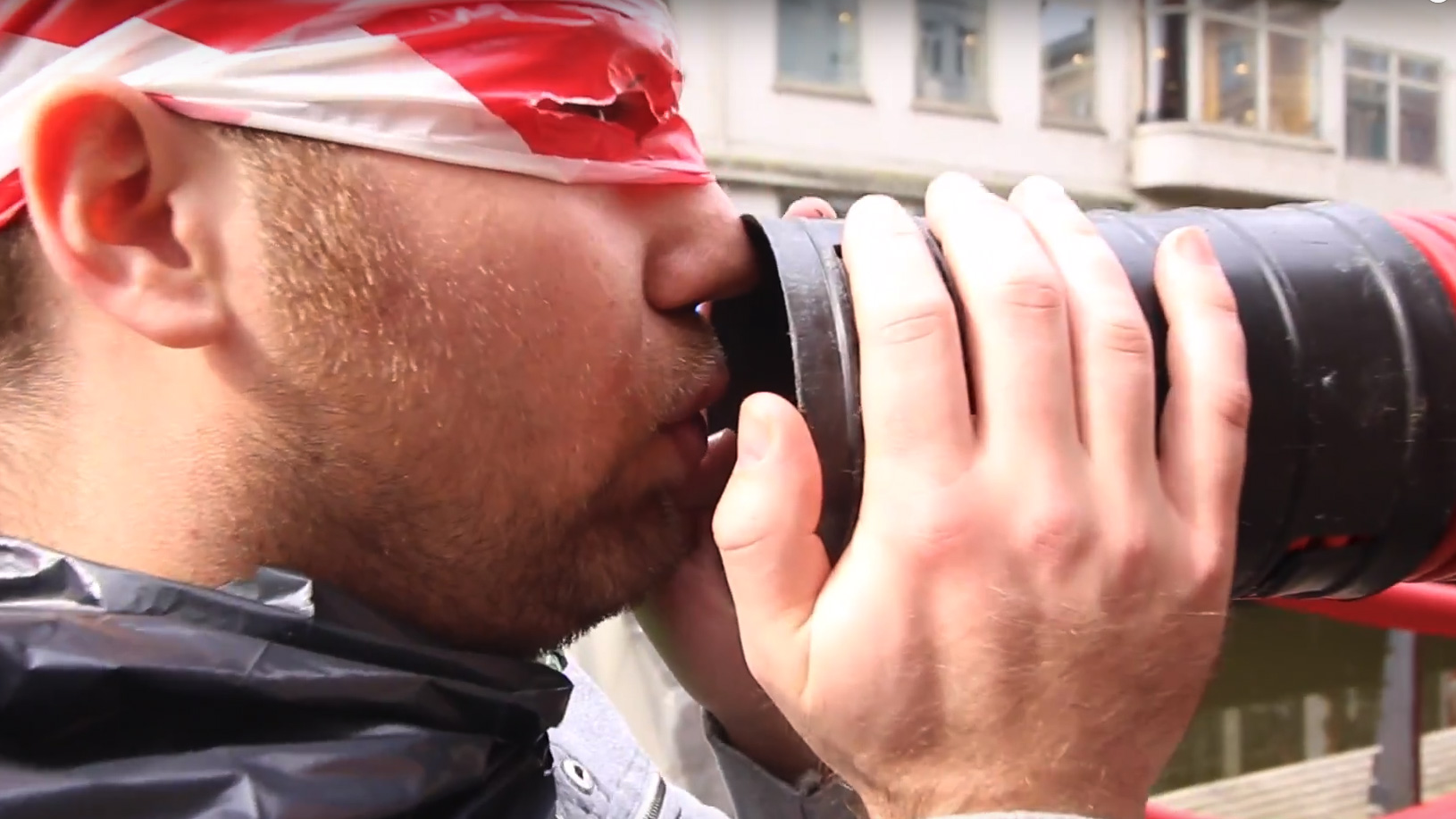
 I aimed for a playful training week, that would mirror the principles of play, we use for