[et_pb_section bb_built=”1″][et_pb_row][et_pb_column type=”4_4″][et_pb_text _builder_version=”3.0.89″ background_layout=”light”]
The classic library is a conundrum in and of itself, a building dedicated to the imaginary worlds of fiction, of curious characters from the minds of authors and playwrights, and a space where you are asked not utter a word louder than your breath, and where more angry stares hit your eyes than at a busy train station.
For us CounterPlayers the library is a valued venue, it is a space for us to explore our ideas, and moreover it’s a collaborator and friend that enables our annual festival to become a reality. My job as a volunteer was to make sure that the allocated rooms and spaces where ready for both participants and hosts, and required both a laptop in one arm and a friendly face when walking around asking students, library guests and the like to kindly leave the space open for our festival.
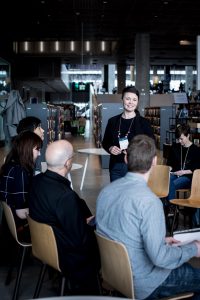 Luckily for me, most students seemed to understand the relevance of a debate staged in the library, others, however, had their doubts as to what a festival of play was doing, first of all in the library, and second of all, why it involved adults.
It was and still is curious to me how the users of such a vast mecca of literature and knowledge are unaware of their own need and desire to play. Are we not, as readers, part of an adventure that far exceeds ordinary life? I would even argue that the pages of non-fiction and newspaper as well as literature require us to step out of our immediate present and let words form the bridge between us and somewhere else. To learn and experience is to take a leap of faith.
Exactly this dilemma was what brought the participants and listeners to the debate in the spring. What are the possibilities of the library, and how do we change the norms adherent to it? Kindergardens, schools and organizations as well as us at CounterPlay, wish for the library to evolve into a room and community that embraces imagination not just in the written word.
Here on our blog I wish to take the question even further: how is it that the library, the home of books, adventures, fairy princesses, epic wars and deceptive murderers is a space of silence? Even the division of a children’s wing indicate a need to separate the immediate imagination and play (and noise?) of children from the seriousness of the adult reader. But I believe that just as much action is present within the mind of the adult reader, and thus the physical space of the library, the seriousness and silence seems to be in clear opposition to the realm of the inner experience.
Perhaps the library should be a place for us to explore and to play, where children are free to move around and experience narrative in their own way? Perhaps a place where old prejudices can be challenged by who knows – a laughing kid, a bubble show, a reading or performance art? Even smaller libraries without the resources for separate rooms for play or immersion might open up the space for a little less quiet and a little more laugh.
We all here at CounterPlay dare you to challenge the conventions of the home of the written word and accept, show and respect the inner need for play and imagination.
[/et_pb_text][/et_pb_column][/et_pb_row][/et_pb_section]